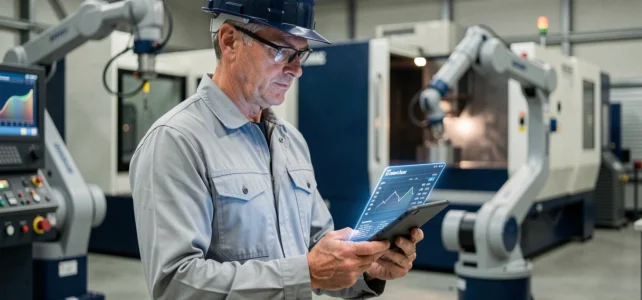
A factory running at full capacity but wasting a quarter of its energy on aging machines is still a common scenario in the French industrial landscape. Optimizing industrial production is not just about producing faster: it’s about producing better, with less waste, by leveraging technological and financial levers often underutilized by SMEs and mid-sized companies.
Green Industry Tax Credit and Public Aid: Concrete Financial Levers
Before discussing robots or software, a major obstacle deserves attention: financing. Modernizing a production line is expensive, and many companies postpone their projects due to a lack of budget visibility.
Since March 14, 2024, the green industry tax credit (C3IV) targets four sectors: batteries, wind energy, solar panels, and heat pumps. To qualify, at least 50% of the revenue must come from downstream activities in these sectors. The scheme, initially set to last until December 31, 2025, has been extended until 2028 under the European CISAF framework. This extension gives manufacturers a medium-term planning window, which changes the game for heavy investments.
Another often overlooked point: since January 1, 2024, the de minimis aid ceiling has increased to 300,000 euros over three fiscal years. A project for robotization or equipment replacement can therefore be supported without notification to the European Commission, as long as it remains below this threshold. Resources like placedesindustries.com help manufacturers identify these opportunities and connect with the ecosystem suited to their sector.
Sensors and Production Data: Managing the Factory in Real Time
You may have noticed that a car dashboard now displays instant fuel consumption, tire pressure, and brake pad wear? The principle is the same in a modern factory, but on a much finer scale.
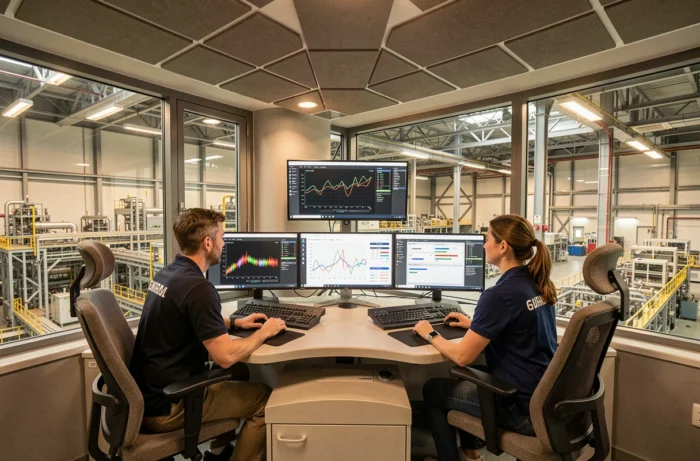
Sensors placed on machines continuously relay data on temperature, vibration, flow, or pressure. This data feeds into a Manufacturing Execution System (MES) software that displays the status of each station in real time. The production manager can spot a slowdown before it turns into a halt.
The next step is predictive maintenance. Instead of replacing a part every six months as a precaution (or waiting for it to break), the algorithm analyzes wear curves and triggers intervention at the right moment. The result: fewer unplanned downtimes and extended equipment lifespan.
What This Means for a Production Line
- Operators receive targeted alerts at their station, not a twenty-page report at the end of the week. They react in minutes, not days.
- Tracking of scrap becomes automatic: each non-compliant part is traced back to its cause (settings, material, temperature), speeding up correction.
- Energy consumption per batch is measured. An abnormal deviation on a furnace or compressor triggers an alert before the bill skyrockets.
This data-driven management does not replace human expertise. It complements it by eliminating blind spots that visual observation cannot cover.
Decarbonization of Industrial Processes: Regulatory Constraint and Competitive Advantage
The energy transition is no longer a distant horizon for French factories. The Sectoral Transition Plans (PTS), led by ADEME, build decarbonization pathways tailored to the technical realities of each sector. This means that objectives are not set abstractly, but co-constructed with the relevant manufacturers.
A telling example: the France 2030 program has supported several heavy decarbonization projects, such as replacing fossil fuel combustion furnaces with electric or hydrogen processes in chemistry and ceramics. Decarbonizing an industrial process reduces dependence on fossil fuels, whose prices remain volatile, and positions the company in markets where buyers demand traceable carbon footprints.
For SMEs, the question is not to transform everything at once. An energy audit can identify the most energy-intensive areas. Often, replacing just one piece of equipment (a compressor, a process heating system) can lead to a significant reduction in the energy bill with a quick return on investment.
Collaborative Robotics and Production Flexibility in Factories
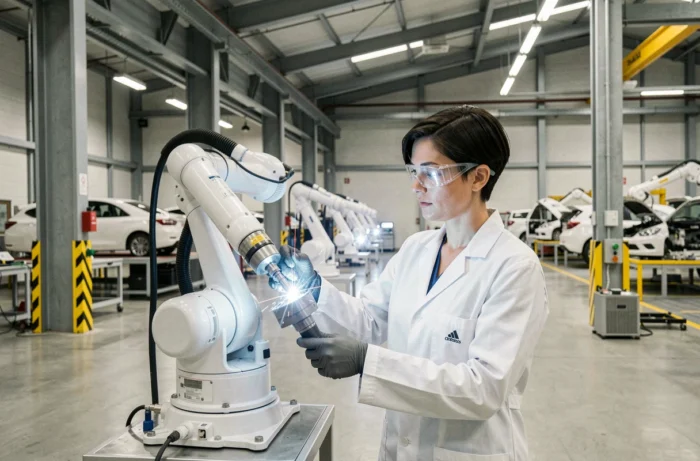
Traditional industrial robotics involves articulated arms behind safety fences, programmed to repeat the same action thousands of times. Collaborative robotics (cobotics) changes this logic.
A cobot works alongside the operator, without a cage. It takes on repetitive or physically demanding tasks (screwing, palletizing, visual inspection), while the human manages adjustments, special cases, and complex quality control. The cobot does not replace the operator; it absorbs the strain.
Why choose this over a traditional robot? Flexibility. A cobot can be reprogrammed in a few hours to switch from one product to another. In a factory that produces short runs or customized products, this adaptability makes the difference between profitability and loss.
Conditions for a Profitable Investment
- Identify positions where cycle time is extended due to fatigue or repetition, not those requiring fine dexterity.
- Train operators in co-utilization from the start of the project to avoid rejection and workarounds.
- Ensure that the production volume justifies the investment: a cobot that pays for itself in less than two years is a good indicator.
The French industry today has a rare alignment of financial incentives, technological maturity, and regulatory pressure. Companies that combine data-driven management, targeted decarbonization, and flexible automation are not just catching up. They are building a sustainable advantage in markets where traceability and efficiency become purchasing criteria, not options.