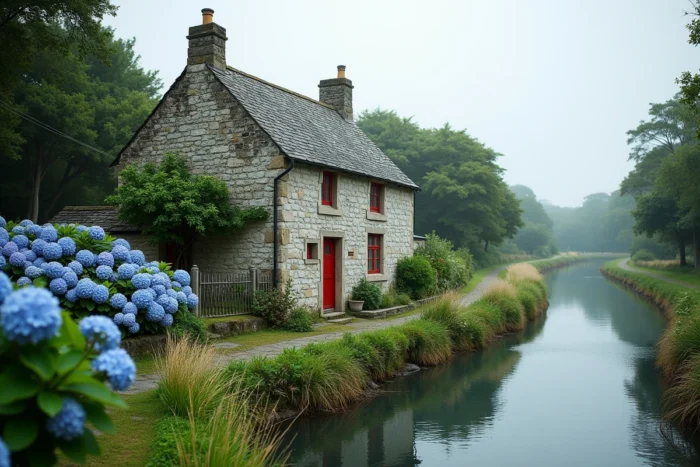
A lock keeper’s house by the Nantes to Brest canal, with its granite walls and its little garden that plunges towards the water. The picture is dreamy. But between this crush and the signing of a deed, the journey has almost nothing in common with a classic real estate purchase. The land status of these buildings changes the very nature of the transaction, and most buyers discover this too late.
Servitudes after declassification: what remains even when you are the owner
One point often goes unnoticed by buyers: even a declassified lock keeper’s house from the public domain and sold as an ordinary property retains constraints related to its position by the canal. The towing and footpath servitudes, for example, require leaving a strip of land along the bank free.
In practical terms, you cannot fence this strip, build a garden shed on it, or install a terrace there. The towing servitude survives the declassification of the building. It is attached to the land, not to the public status.
Other constraints may apply depending on the location. Wetlands adjacent to Breton canals may fall under specific environmental protections. Before signing, check with the town hall if the land is subject to a wetland perimeter, a coastal risk prevention plan (PPRL), or a previous natural disaster decree. A notary specialized in rural or river law will be able to identify these charges in the property title and in the urban planning documents.
To fully understand the steps to buy a lock keeper’s house, you must first understand that the legal framework is never limited to just the sales deed.
Check the public status of a lock keeper’s house in Brittany
Why does this step condition everything else? Because a lock keeper’s house can be in two radically different situations: still attached to the regional public domain, or already declassified and transferred to the private domain.
If the building still belongs to the public domain, no classic sale is possible. The only legal framework is then the temporary occupation agreement (COT), which grants a limited right of use over time, without transfer of ownership.
To know the precise status of a house, contact the canal manager directly. In Brittany, the Region owns the majority of navigable waterways and their dependencies since the transfer related to decentralization. The Brittany canal service can confirm whether a building has been declassified or remains in the public domain.
Temporary occupation agreement or sales deed
The distinction is simple in principle, but its consequences are significant:
- The COT grants a precarious and revocable right of use. You do not own the property, you cannot resell it, and any work is subject to the authorization of the public owner.
- Prior declassification is the only path to a full ownership purchase. It requires an administrative decision from the community, which removes the property from the public domain to place it in its private domain.
- Even after declassification, the sale may go through a call for projects or an auction, not through a classic private negotiation.
A buyer who confuses these two frameworks risks investing in work on a property they are not certain to keep.
Calls for projects from the Brittany Region: how to access a lock keeper’s house
The current trend in Brittany is regulated conversion. The Region is not simply looking to get rid of vacant buildings. It selects project holders capable of reviving these places, often with a tourist, cultural, or associative dimension.
Calls for projects are the main access channel to Breton lock keeper’s houses. The Region regularly publishes notices for buildings located along the Blavet, the Ille-et-Rance canal, or the Nantes to Brest canal.
Selection criteria and file preparation
The file is not limited to a financial offer. The Region assesses the coherence of the project with the enhancement of river heritage. You will need to present a usage plan, a projected rehabilitation budget, and a medium-term vision for the site.
A purely private residential project is less likely to be selected than a guesthouse, a nautical stop café, or an artisan workshop. This filter surprises many individuals who imagined buying a second home by the water.
Hydraulic risks and local compliance: the forgotten aspect
Lock keeper’s houses are built right by the water. This architectural fact translates into direct exposure to floods, groundwater rises, and, for canals near the coast, marine submersions.
Before committing, check three concrete elements:
- The existence of a flood risk prevention plan (PPRI) or coastal (PPRL) in the municipality. This document may prohibit certain types of work or impose elevations.
- The history of natural disaster decrees on the parcel. The town hall and the prefecture maintain these records.
- The condition of hydraulic structures (lock, spillway, sluice) adjacent to the house. A poorly maintained structure can worsen the risk of flooding in the event of a flood.
These verifications are not optional. They also condition the possibility of obtaining home insurance under reasonable conditions, and may impact the resale value of the property.
Buying a lock keeper’s house in Brittany remains a feasible project, provided that the public status is treated as a prerequisite, not as an administrative detail. The granite building by the canal does not wait for just any buyer: it awaits a project holder ready to navigate a legal framework that is anything but ordinary.