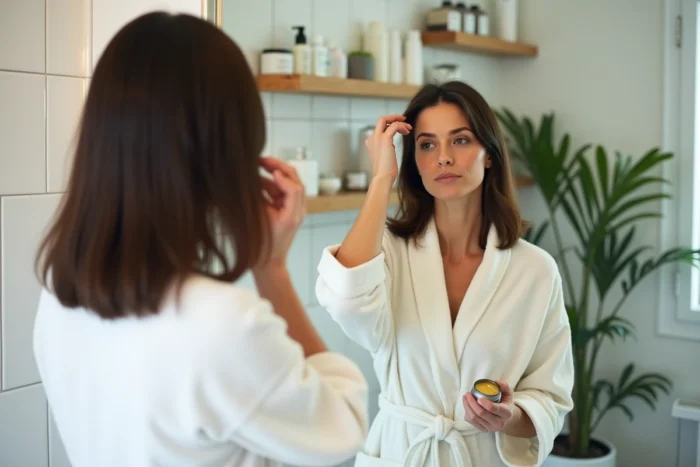
The Vermogal ointment is a cosmetic anti-parasitic product designed to eliminate lice from the scalp. Despite its popularity, particularly in the Maghreb and among certain communities in France, its use remains surrounded by persistent confusions. Many attribute hair growth or beautifying properties to it, while its primary function strictly aims at treating a parasitic infestation.
Vermogal and bioallethrin: what the ointment really contains
Vermogal contains bioallethrin, an active substance from the pyrethroid family. This molecule acts on the nervous system of lice, causing their paralysis and then death. Its action is targeted at the parasites, not at the hair fiber.
The confusion arises from the fact that some users notice “cleaner” or “lighter” hair after treatment. This result is explained by the elimination of parasites and their nits, which irritated the scalp and caused itching and micro-inflammations. Vermogal does not nourish the hair, does not stimulate its growth, and does not replace any hair care.
To delve deeper into the use of Vermogal ointment in France, one must first accept this pharmacological reality: the product treats an infestation, it does not transform the quality of the hair.

Application on dry hair and scalp: the protocol to follow
The instructions recommend applying Vermogal on dry hair and scalp. This point is often overlooked. Moisture dilutes the product and reduces the contact of bioallethrin with the parasites, which decreases its effectiveness.
The application should be done in a well-ventilated area. The ointment contains volatile solvents whose prolonged inhalation in a confined space can cause respiratory irritation.
Concrete actions during application
- Evenly distribute the ointment over the entire scalp, paying special attention behind the ears and at the nape of the neck, areas where nits concentrate the most.
- Do not cover the hair with a rubber or plastic cap during the application, contrary to what some online articles suggest. The instructions explicitly discourage this practice.
- Do not use a hairdryer after application. The heat combined with the solvents presents a real risk, as the product is flammable.
- Protect the eyes and mucous membranes during application. In case of contact, rinse thoroughly with clear water.
The application time varies according to the available formulations. Always adhere to the time indicated on the packaging of the purchased product, without extrapolating from advice found on forums.
Treatment frequency and reapplication
An anti-parasitic treatment does not work like a weekly hair mask. Vermogal is used occasionally, during a confirmed infestation. Repeating the application without an active infestation irritates the scalp and can cause dryness, flaking, or allergic reactions.
When a second application is necessary (persistence of living nits), it generally occurs after a specific delay mentioned in the instructions, allowing the unhatched nits from the first application to become vulnerable. This renewal should not be done randomly or anticipated as a precaution.
Common confusions about frequency
Online discussions show a recurring confusion between curative use and preventive use. Some users apply Vermogal “once a month” to prevent lice. No medical source validates this approach. Anti-parasitic treatments are not repellents and their regular preventive use has no basis.
Vermogal and hair loss: separating fact from fiction
The question frequently arises in French-speaking forums: does Vermogal promote hair growth or, on the contrary, cause hair loss? The answer lies in a simple distinction.
Bioallethrin has no demonstrated effect on the hair growth cycle. It does not act on the hair follicle, keratin, or the microcirculation of the scalp. Positive testimonials about “regrowth” after treatment are explained by the end of parasitic irritation: a scalp freed from lice returns to its normal state, which can give the impression of hair improvement.
Conversely, too frequent use or excessive application time can weaken the hair fiber. The solvents in the formulation dry out the hair if the product is left on beyond the recommended duration. The result: brittle hair, a feeling of loss of volume, or even slight and temporary hair loss.
Complementary products after Vermogal treatment
After rinsing Vermogal, the scalp has undergone a chemical treatment. An appropriate restorative care helps restore natural hydration.
- A gentle shampoo, free from harsh sulfates, to remove residues without adding further irritation.
- A moisturizing conditioner or mask to compensate for the drying effect of the solvents on the lengths.
- A fine nit comb to mechanically remove dead nits after treatment, a step often overlooked but crucial to avoid apparent reinfestation.
These post-treatment actions are not a cosmetic luxury. They directly contribute to the recovery of the scalp and limit hair breakage often wrongly attributed to Vermogal itself.
Vermogal remains an effective anti-parasitic tool when used within the framework intended by its formulation. Following the instructions and limiting use to actual infestations protects both the scalp and the quality of the hair in the long term.