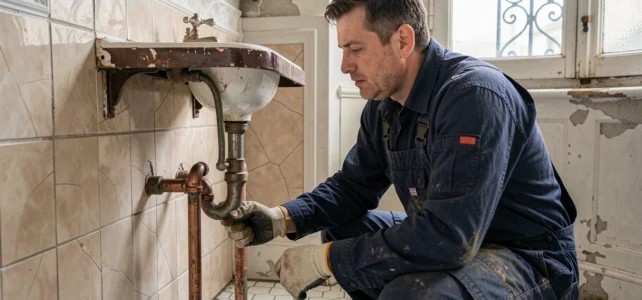
A classified apartment in Brussels imposes a specific legal framework as soon as its technical installations are involved. Plumbing, because it sometimes runs through load-bearing walls, cornices, or original ducts, finds itself at the intersection of two logics: that of sanitary comfort and that of heritage conservation. Understanding this framework before contacting a contractor can prevent months of administrative blockage.
Unique permit and well protected: the administrative lock on plumbing
In a non-classified Brussels building, interior plumbing work (replacement of pipes, redistribution of water inlets, installation of a new water heater) is exempt from urban planning permits. They fall under the category of transformation and interior development work, provided that neither the number nor the distribution of housing units is modified.
For a classified property, the rule changes radically. Any action on a protected property requires an urban planning permit, issued according to the so-called “unique permit” procedure. This permit simultaneously addresses urbanistic and heritage aspects. It is not processed by the municipality, but by the delegated official, in consultation with the cultural heritage and urban planning departments of the Brussels-Capital Region.
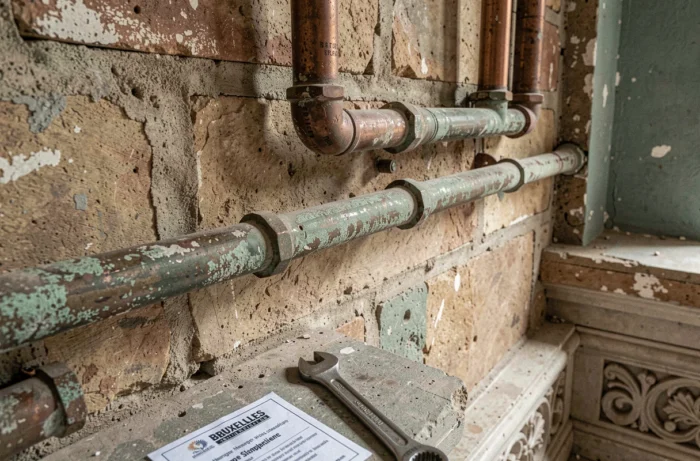
Specifically, even replacing a lead riser with copper or multilayer can trigger this procedure if the layout crosses a protected element. The constraints for renovating plumbing in Brussels are influenced as much by the nature of the building as by the legal status of the property.
Heritage elements and pipe layout: what blocks in practice
The classification protects specific architectural elements: moldings, stuccos, period tiles, interior woodwork, and sometimes even the layout of rooms. A plumber used to standard sites may propose a direct layout between the kitchen and the bathroom by drilling through a partition. In a classified apartment, this partition may be an inventoried element.
Technical ducts and common areas
Drainage and supply columns often pass through shared ducts. In a classified condominium building, any intervention on these ducts affects the common areas. It is then necessary to obtain the agreement of the general assembly of co-owners, in addition to the unique permit.
The condominium regulations take precedence over the individual owner’s wishes. A technically feasible project may be refused because it requires access to the ducts from another private unit, or because it alters the water pressure in the upper floors.
Frequent workaround solutions
- Running new pipes visibly or semi-recessed along the baseboards to avoid drilling into protected walls. The aesthetic result is less discreet, but the heritage procedure is simplified.
- Using flexible multilayer fittings that follow existing cavities (false ceilings, recent linings) without touching the original structure.
- Planning a preliminary consultation with the cultural heritage department even before submitting the permit application. This step, recommended by patrimoine.brussels, allows for adjustments to the project in advance and avoids outright refusals.
PEB certificate and hot water production: the energy constraint that adds up
The renovation of plumbing in a classified apartment is not limited to the conservation of the building. The Brussels-Capital Region is gradually strengthening its requirements regarding energy performance of buildings (PEB). The PEB certificate, mandatory for any sale or rental, evaluates, among other things, the hot water production installation.
Replacing an old gas water heater with a more efficient model, or even with a thermodynamic water heater or a heat pump, becomes a lever to improve the energy class of the housing. In a classified property, the installation of an outdoor heat pump unit on a protected facade will most likely be refused.
The production of sanitary hot water is a central point of arbitration between energy performance and respect for heritage. The least visually intrusive solutions (thermodynamic water heater using ambient air installed in a basement or an interior technical room) are often the only ones compatible with the classification.
Application file and coordination with the architect: preparing a unique permit for plumbing
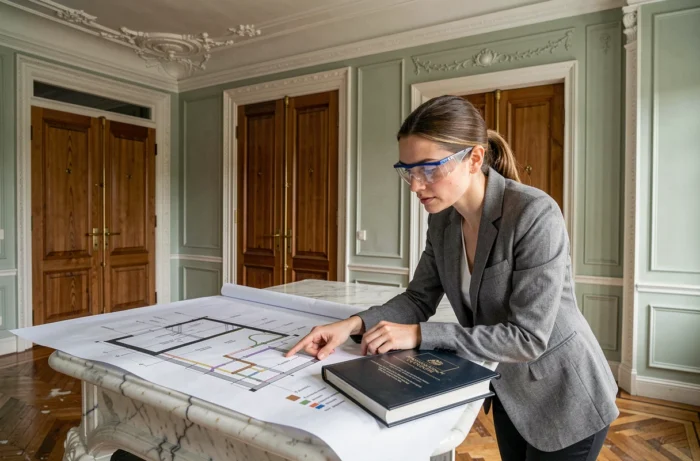
The unique permit requires a complete file, established by the applicant and their architect. For plumbing work in a protected property, this file must demonstrate that the intervention respects the conservation conditions defined during the classification.
In practice, it is necessary to provide:
- A photographic survey of the existing state of the installations and the heritage elements affected by the pipe layout.
- Detailed plans showing the proposed routing of the pipes, indicating the materials used and the fixing points.
- A justification note explaining why the chosen layout is the least intrusive possible for the heritage, and which alternatives have been ruled out.
- The prior opinion of the co-ownership if the work affects common areas or shared ducts.
Consultation with the relevant departments before the application is the factor that most shortens processing times. A file submitted without this preliminary step often comes back with requests for modifications that add several months to the timeline.
The architect coordinates the heritage aspect, but the plumber must be involved from the design phase. A contractor who discovers the classification constraints on the day of the work generates avoidable costs and delays.
The register of protected properties, accessible on the patrimoine.brussels website, allows you to check the exact status of a building and the extent of its protection before initiating any process. This verification takes a few minutes and conditions the entire project.