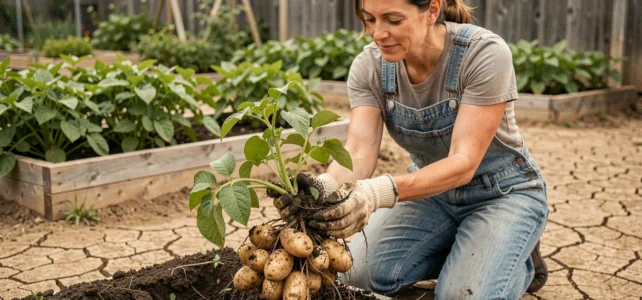
The date for harvesting potatoes is not found on a calendar. It depends on the variety planted, the weather experienced during the growing season, and the actual condition of the foliage at the time the gardener inspects the rows.
In recent seasons, episodes of drought in France have complicated the reading of usual signals, causing premature yellowing of the leaves unrelated to the maturity of the tubers. Knowing how to distinguish between climatic drying and normal senescence changes the final result in the storage bin.
Water stress and false maturity signals in the vegetable garden
The classic marker for triggering the harvest remains the yellowing of the foliage. The leaves droop, the plant stops supplying the tubers, and the gardener takes out the fork. This pattern works during normal seasons.
The repeated droughts observed in recent years have changed the game. The foliage can yellow and dry out much earlier than usual, forcing one to harvest everything before the appropriate maturity to save part of the production. This phenomenon also affects amateur gardens: dry soil accelerates the senescence of the plants without the tubers having finished growing.
In practice, if your leaves are yellowing during a heatwave while the planting is less than three months old, it is better to dig up a test plant rather than generalize the uprooting. The tubers of a plant stressed by heat are often smaller than normal, with a still thin skin that easily comes off with friction. This tactile test remains the most reliable way to judge actual maturity, regardless of the color of the foliage.
To delve deeper into the visual criteria and the right reflexes according to the stage of your plants, the simplest approach is to rely on a guide that details how to successfully harvest potatoes based on the actual growing calendar.
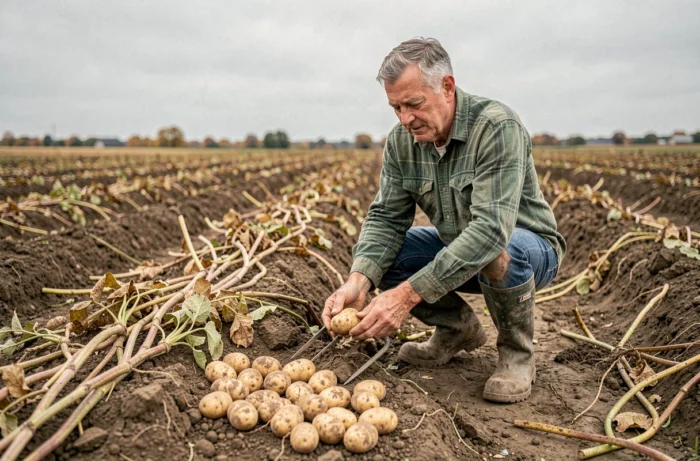
Early, mid-season, and late potatoes: very different harvest windows
The most common confusion in the vegetable garden concerns grouping all varieties under the same calendar. The earliest varieties can be harvested as soon as 90 days after planting, which is from July for a typical spring planting. Late varieties, on the other hand, sometimes require up to five months of cultivation and are only harvested in September.
Early potatoes: a harvest before full maturity
Early potatoes are intentionally harvested before the foliage yellows. Their skin is thin, their flesh moist, and they only keep for a few days. The harvest occurs when the tubers reach a sufficient size for consumption, usually at the time of flowering.
Early potatoes do not keep: it is a harvest for immediate consumption. Storing them in a silo or a dark room will not extend their lifespan beyond a week.
Storage varieties: waiting for complete senescence
For potatoes intended for winter storage, the maturity of the tuber is the determining criterion. The skin must resist the friction of the thumb without coming off. This resistance means that suberization (the natural thickening of the skin) is sufficient to protect the flesh for several months.
Harvesting storage varieties too early results in tubers with fragile skin, vulnerable to mechanical injuries and storage pathogens. Conversely, leaving the tubers in the ground too long after the complete death of the foliage exposes them to the risk of rot if the soil remains moist, or greening if soil cracks allow light to penetrate.
Uprooting technique: mistakes that damage the harvest
Most guides recommend using a garden fork. This is a good choice, provided it is inserted far enough from the plant base to avoid piercing the tubers. The safety distance is about one spade blade length from the base of the plant.
- Prefer a tool with flat or rounded tines rather than pointed ones, which pierce the tubers at the slightest contact
- Always work in dry weather: sticky soil increases mechanical injuries and complicates drying after uprooting
- After lifting the clump, sift the soil by hand to a depth of 15 to 20 cm to recover tubers that remain in place, often the largest
- Never pull on the foliage to extract the potatoes: the stem breaks and the tubers remain buried
Injured tubers at uprooting do not keep. Any potato that is cut or deeply scratched should be consumed within a few days, never stored.
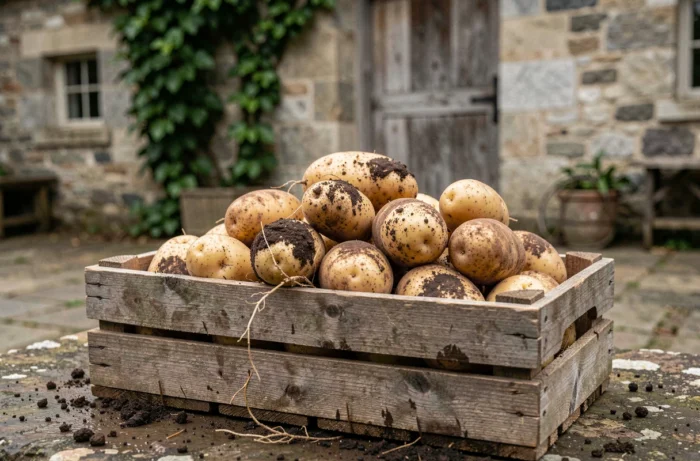
Drying and greening: what happens just after uprooting
Once dug up, potatoes must dry on the ground for a few hours. This drying step allows the skin to harden slightly and for soil residues to detach naturally. Leaving the tubers exposed to the sun for too long causes greening, a sign of solanine production, a toxic compound.
Drying should be done in the shade or at the end of the day, never in prolonged direct sunlight. A few hours are sufficient. Beyond that, the risk of greening becomes real, even in overcast weather if the light remains strong.
- Spread the tubers in a single layer on the garden soil or on cardboard, never stacked
- Bring the harvest into a dark, cool room (between 6 and 10 degrees) as soon as the skin is dry to the touch
- Sort immediately: separate injured, green, or suspiciously spotted tubers from the batch intended for storage
The storage area should be neither too dry (the tubers shrivel) nor too humid (risk of rot and early sprouting). An unheated cellar, shielded from light, with high humidity and complete darkness, remains the most realistic option for amateur gardeners.
Recent campaigns show that drought produces crops with smaller tubers and sometimes less resistant skin. A rigorous sorting at harvest and a short drying period in the shade make the difference between a reserve that lasts until December and potatoes that are good to throw away by October.