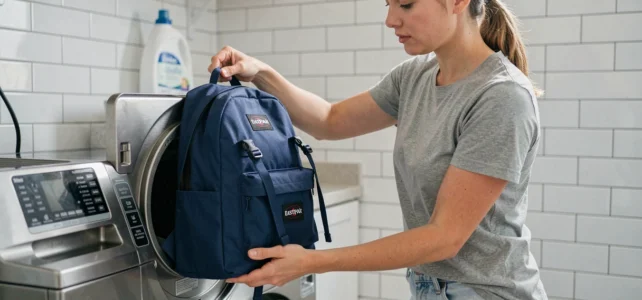
Your Eastpak bag has gone through years of classes, daily commutes, or travels, and it’s starting to show signs of wear. The temptation to throw it directly into the washing machine is strong. But the care label sewn inside usually indicates spot cleaning with a damp sponge, not a machine cycle. So, how do you refresh it without risking distortion or damaging its coatings?
What the Eastpak label really says about washing
Before touching your washing machine’s settings, turn your bag inside out and read the care label. It’s the label that makes the final call, not a generic tutorial found online. For most Eastpak models made of polyester (Padded Pak’r, Pinnacle, Day Pak’r), the brand recommends localized cleaning with a damp sponge.
Recent product sheets from Eastpak go further: they systematically favor hand washing for several references. This is not just a marketing precaution. Eastpak bags often have a water-repellent coating applied to the fabric, and machine cycles, even gentle ones, accelerate the degradation of this protective layer.
If your bag does not carry any symbol allowing machine washing, the official position is clear: do not improvise. Before deciding to wash an Eastpak bag in the machine, check that the label does not explicitly prohibit it with the crossed-out tub pictogram.
Machine washing an Eastpak bag: precautions to limit damage
You’ve checked the label, and your polyester or nylon model has no formal prohibition? A machine wash is still possible, provided you follow several precautions that make all the difference between a refreshed bag and a distorted one.
Prepare the bag before the drum
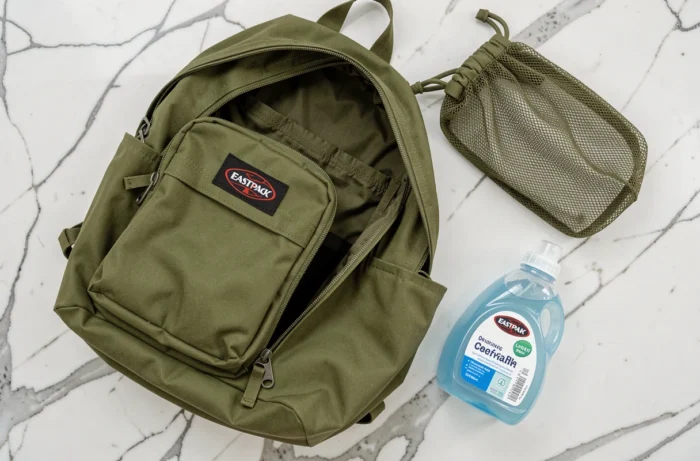
Empty all pockets, including zippered inner compartments. A forgotten paperclip or pen can puncture the fabric during the spin cycle. Remove any detachable items: carabiner, keychain, padded laptop insert. These rigid parts increase mechanical friction in the drum.
Turn the bag inside out and close all zippers. This way, the outer fabric will be protected from direct contact with the stainless steel drum. Then slip the bag into a pillowcase or a mesh laundry bag to limit snags.
Machine settings
Here are the settings to follow for a wash without unpleasant surprises:
- Delicate or wool program, cold or at a maximum of 30 °C: heat weakens the coatings and can melt some internal heat-sealed parts.
- Spin reduced to a minimum, or turned off: a fast spin distorts the straps and reinforcement seams.
- Mild liquid detergent, without bleach or fabric softener: powder soap leaves residues in the corners of the bag, and fabric softener clogs the pores of the water-repellent fabric.
Never put a bag alone in an empty drum. Add a few towels to balance the load and cushion the shocks.
Stubborn stains and targeted cleaning before the machine
A machine cycle will not remove a deep ink stain or a sugary drink ring. For these specific stains, a localized cleaning with Marseille soap remains more effective than any program.
Moisten the stained area with warm water. Apply a small amount of soap directly onto the stain and scrub with a soft-bristled brush (an old toothbrush works perfectly). Rinse with clear water, then blot with a clean cloth. This pre-treatment removes most of the dirt. The machine wash, if you deem it necessary afterward, then serves as a thorough rinse rather than a true cleaning.
Have you ever noticed that some stains return after drying? This is often because the soap was not completely rinsed out. A thorough rinse with clear water is just as important as the cleaning itself.
Drying the Eastpak bag: the step where everything matters
Drying is probably the most underestimated phase. Poor drying damages a bag more than a slightly vigorous wash.
Never put an Eastpak bag in the dryer. Heat damages zippers, softens the plastic reinforcements on the back, and detaches heat-sealed elements. Even a low-temperature cycle is still too aggressive.
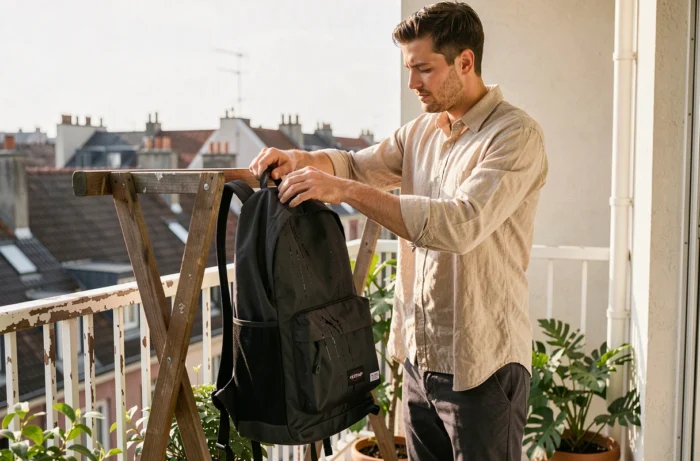
Hang the bag upside down, open, in a ventilated area away from direct sunlight. UV rays fade polyester over time. Leave all pockets open to allow air to circulate inside. Complete drying usually takes one to two days depending on the thickness of the fabric and the ambient humidity.
To speed up the process safely, place a rolled dry towel inside the bag. It will absorb residual moisture and help the bag maintain its shape.
Protective spray after washing: extending the fabric’s resistance
A detail that competitors rarely address: protection after cleaning. Eastpak recommends applying a universal protective spray once the bag is clean and completely dry. This product partially restores the water-repellent layer degraded by washing.
Apply the spray in a thin, even layer over the entire outer fabric. Allow to dry according to the product instructions (often a few hours). This simple step extends the life of the coating and reduces the frequency of future washes, as stains adhere less to the treated fabric.
Washing an Eastpak bag in the machine is not prohibited for all models, but it remains a last resort solution. Targeted cleaning with soap, careful rinsing, and air drying are sufficient in most cases. Reserve the machine for heavily soiled bags, following gentle settings, and always finish with a protective spray to compensate for wear on the coating: this is the combination that keeps an Eastpak looking presentable for years.