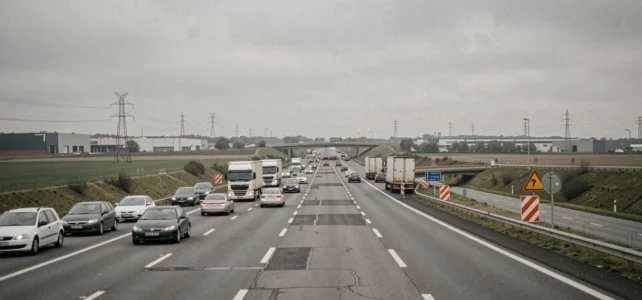
In France, the motorway network totals approximately 12,000 kilometers and accounts for a significant share of long-distance traffic. Despite an infrastructure designed for speed, motorway fatalities are experiencing a concerning rise. According to the ASFA’s 2025 safety report, 162 people were killed on the toll motorways in 2025, compared to 129 in 2024, representing a 26% increase.
Understanding which French motorways are the most dangerous first requires clarifying what the danger indicators measure.
Fatality rate per kilometer traveled: the measure that changes everything
Classifying a motorway as “dangerous” based on the raw number of accidents skews the analysis. A heavily trafficked motorway mechanically records more collisions than a less frequented route. The fatality rate per billion kilometers traveled allows for comparisons between sections with unequal traffic.
On this criterion, the motorway remains the safest network in France. The risk of a fatal accident per kilometer driven is several times lower than that on departmental or national roads. A detailed analysis of accident risks on French motorways confirms this hierarchy among networks.
The confusion arises from volume. The A7 or A10 accumulate incidents because they handle colossal traffic, not because their design is more flawed than elsewhere. When adjusted for vehicle-kilometers, these routes do not necessarily top the danger ranking.
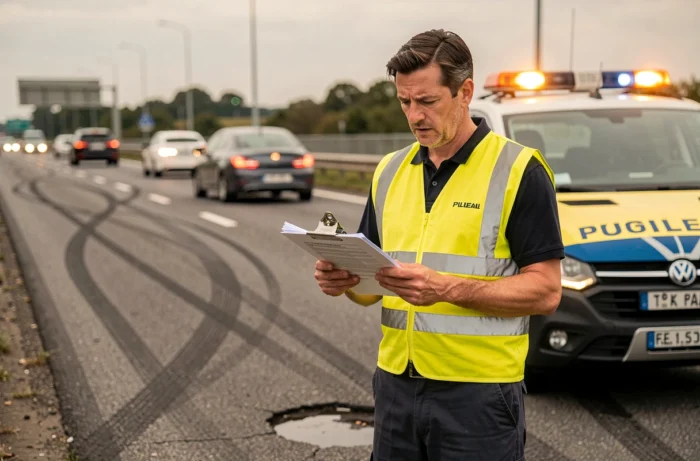
Motorways A7, A10, A6: why dense traffic multiplies accidents
Some motorways consistently appear in accident reports. Three factors combine on these routes.
- Seasonal saturation: the A7 (Rhône Valley) and A10 (Paris-Bordeaux) experience traffic peaks during summer holiday crossovers, sometimes with over 1,000 kilometers of traffic jams according to Bison Futé during black Saturdays.
- Lapse of vigilance: on long, straight stretches, the monotony of the journey promotes hypovigilance. Drivers maintain high speeds while reducing their attention, a phenomenon documented by ONISR studies.
- Traffic heterogeneity: heavy trucks, camper vans, vehicles towing caravans, and fast sedans coexist on two or three lanes. The speed differences among users generate frequent overtaking maneuvers and sudden braking.
The A6, the Paris-Lyon route, shares these same characteristics with an additional difficulty: sections with elevation changes that alter the behavior of heavy vehicles on descents.
The specific case of the A7 in summer
The Sun Motorway concentrates a disproportionate share of serious accidents between June and August. The heat exacerbates fatigue, and the density of traffic reduces safety distances to sometimes ridiculous values. Toll areas, where traffic shifts from motorway speed to complete stop, constitute recurring collision points.
Increase in motorway fatalities in 2025: a reversal of trend
The ASFA report for 2025 marks a turning point. With 144 fatal accidents compared to 114 in 2024, the downward trend observed in previous years has reversed. ONISR confirms in its barometers that this deterioration specifically affects the motorway network, while other networks remain relatively stable.
Several risky behaviors explain this increase. Excessive speed remains the primary identified cause. The use of mobile phones while driving has also significantly increased in recent years, and its effects are amplified on motorways where a second of inattention at 130 km/h represents over 36 meters traveled blindly.
Drowsiness is involved in a notable share of fatal accidents on motorways. Long straight stretches, air conditioning, and night driving create a cocktail conducive to falling asleep, particularly on night holiday trips.
Toll motorways vs. free motorways: an unknown safety gap
The French motorway network is divided into two categories with distinct safety profiles. Toll motorways benefit from maintenance funded by toll revenues: regularly renewed surfaces, dynamic signage, security patrols, and well-maintained rest areas.
Non-toll motorways, managed directly by the state, have more constrained maintenance budgets. Some sections exhibit characteristics similar to expressways (absence of a central divider on certain stretches, reduced shoulders) that increase the severity of collisions.
Motorway profile and accident severity
The width of the central reservation, the presence of concrete or metal guardrails, the spacing of exits, and the quality of lighting directly influence the toll. A section without a rigid divider multiplies the risk of head-on collisions, the deadliest type of accident on fast roads.
Older motorways, built in the 1960s-1970s with less demanding design standards (sharper curves, narrower emergency lanes), retain a structural over-risk even after renovation.
Ranking of dangerous motorways: what raw numbers don’t tell
A ranking based solely on the number of accidents places the most trafficked motorways at the top. A ranking adjusted for traffic highlights lesser-known but riskier sections per journey made. The two readings are complementary.
Data from ONISR, cross-referenced with ASFA reports, allow for the identification of accident hotspots related to specific configurations: complex interchanges, lane reductions, prolonged work zones. These localized black spots weigh more heavily in the toll than a diffuse danger across an entire route.
The 26% increase in motorway fatalities in 2025 serves as a reminder that safety on motorways is not guaranteed. The safest network per kilometer traveled is also the one where impact speeds are the highest, and where every human failure comes at a high price.