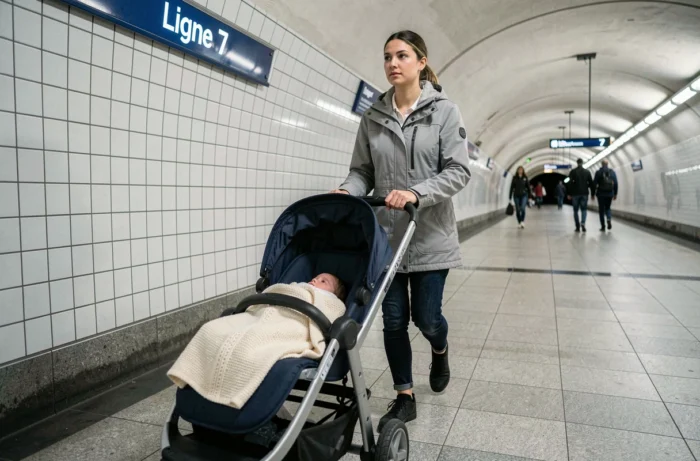
Line 7 of the Paris metro connects La Courneuve in the north to Villejuif and Ivry-sur-Seine in the south, crossing the heart of Paris with more than thirty stations. For users in wheelchairs, with strollers, or any other mobility aid, this route presents a concrete problem: the vast majority of the stations on this line do not have a continuous path without stairs between the street and the platform.
The Paris metro network, historically designed without consideration for accessibility, remains largely impractical for people with reduced mobility. Line 7, one of the busiest in Île-de-France, illustrates this reality with particular acuity.
Line 7 and Accessibility for People with Reduced Mobility: What the Entry-by-Entry Analysis Reveals
Standard guides simply indicate whether a station has an elevator. This approach masks a major difficulty: accessibility varies depending on the chosen entrance at the same station. A station may show an elevator on the RATP map while remaining impractical from the closest exit to your destination.
Services like Transit now detail, for each station on line 7, whether the entrances are accessible by wheelchair or with a stroller. The data shows that stations like Le Peletier, Porte d’Italie, or Villejuif – Louis Aragon are not accessible to travelers using a wheelchair, a mobility aid, or a stroller. This observation applies to most stops on the line.
For those who want to know everything about metro accessibility on this section, the first useful reflex is to check each entrance individually before traveling, rather than relying on the overall pictogram of the station.
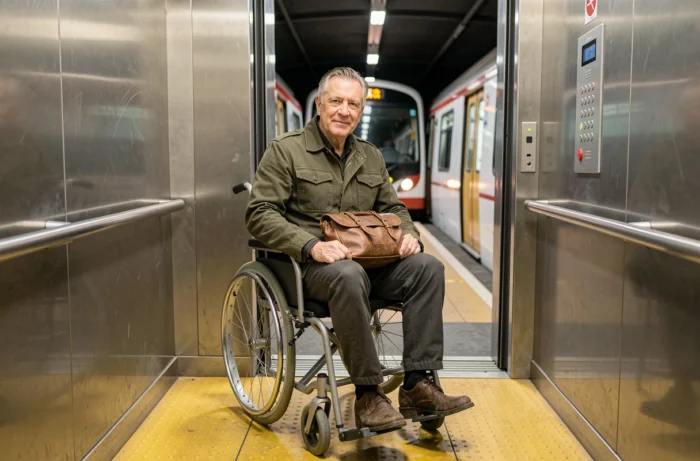
Stations on Line 7 with Elevators: A Limited Inventory
The number of stations actually equipped with a functional elevator on line 7 remains very low compared to the total number of stops served. Île-de-France Mobilités publishes an open dataset (SDAP) that lists stops associated with accessibility features. By cross-referencing this data with the layout of line 7, we find that only a handful of stations offer a complete path without steps.
Moreover, the elevator must be in service. Breakdowns, frequent on an aging network, turn a theoretically accessible station into a dead end. No reliable real-time alert mechanism is integrated into RATP applications to report these malfunctions before the user is already on site.
North Section: La Courneuve – Opéra
The northern section of line 7 passes through deep stations, often equipped with long transfer corridors. The passage between Gare de l’Est and Opéra, highly recommended for tourists, remains very little accessible for strollers and people with reduced mobility due to multiple stairs and the absence of elevators in several intermediate stations.
Connections at Stalingrad or Gare de l’Est with other lines add additional levels to cross. A parent with a stroller attempting this connection often has to carry all the equipment up several flights of stairs.
South Section: Châtelet – Villejuif / Ivry
The southern branch towards Villejuif – Louis Aragon, despite its more recent character in some sections, does not escape the problem. Villejuif – Louis Aragon itself is not accessible to users in wheelchairs or with strollers. The terminus therefore does not guarantee a passable route from end to end.
Concrete Alternatives for Traveling Along Line 7
In light of these shortcomings, several strategies exist for families and people with reduced mobility who need to use the route of line 7.
- The bus often constitutes the most reliable alternative: nearly all bus lines in the Île-de-France region are accessible to wheelchairs and strollers thanks to low floors and deployable ramps. Several bus lines follow routes parallel to line 7.
- The T3 tramway, fully accessible, allows access to certain stations in southern Paris without going through the underground metro.
- The Île-de-France Mobilités app offers an accessible route calculator that filters journeys based on the type of mobility. This service, also reachable by phone at 09 70 81 83 85, allows users to check the status of facilities before departure.
Choosing the bus over the metro represents a real time-saving for users with reduced mobility along the route of line 7, even if the journey is longer in distance.
New MF19 Trains and Prospects for Line 7
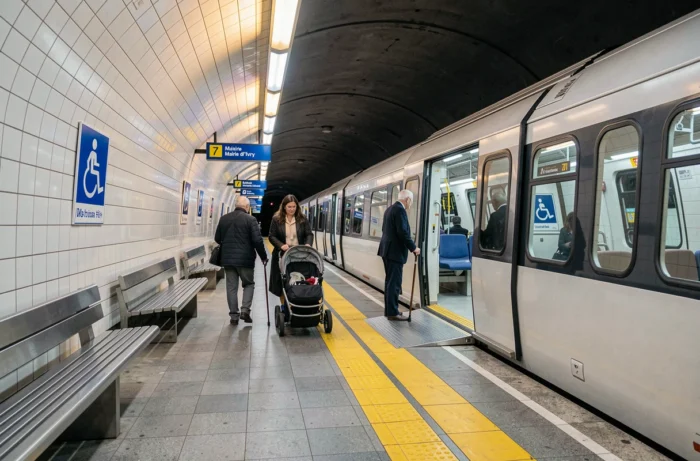
The renewal of the rolling stock of the Paris metro is progressing. The new MF19 trains, which are set to enter service starting in 2027 on certain lines, include dedicated spaces for wheelchairs and strollers, with reduced platform-to-train gaps. Line 13 is among the first to be affected.
For line 7, no specific deployment schedule has been communicated at this stage. The rolling stock does not solve the problem of the stations themselves: without an elevator between the street and the platform, an accessible train remains inaccessible. Field feedback varies on Île-de-France Mobilités’ actual capacity to equip the oldest stations, where architectural constraints (narrow vaults, significant depth) complicate the installation of elevators.
The Accessibility Master Plan (SDAP) of Île-de-France Mobilités sets objectives for accessibility improvements, but the associated open data shows that the pace of equipment installation remains slow compared to the number of affected stations.
Line 7 concentrates the contradictions of the Parisian network: very busy, central to daily travel, but structurally hostile to users who cannot use stairs. As long as the installation of elevators has not caught up with the accumulated delay, checking each station entrance individually remains the only reliable precaution to avoid finding oneself stuck at the top of a staircase with a stroller or wheelchair.