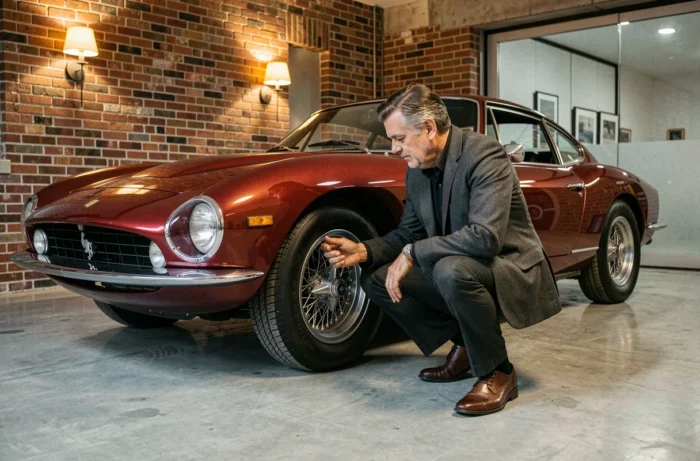
The classic car market has seen a notable increase in its liquidity in recent months. According to data published by Interencheres, the number of ownership changes of classic vehicles at auctions rose by 31% between 2024 and 2025. This resurgence of activity is not limited to traditional prestige models: the most dynamic valuations now involve cars from the 1980s, 1990s, and the “instant classics” from 2000-2011.
Classic car valuations: what recent transactions reveal
Narrowing the collector market down to vintage Ferraris and Porsches no longer reflects the reality of sales. Available data shows that the recovery in valuations, following a decline the previous year, is driven by more recent models. Youngtimers and vehicles produced between 2000 and 2011 are capturing an increasing share of demand.
The generational renewal of collectors fuels this trend. Buyers entering the market are looking for cars from their own youth. An Alpine A110 from the 2010s or a Bugatti Veyron generates interest today that did not exist ten years ago in auction rooms.
Field reports diverge on the sustainability of this movement. Some specialists see it as a classic speculation cycle on recent models, while others view it as a structural shift in the profile of enthusiasts. The 31% increase in auction transactions remains a strong signal, regardless of the interpretation adopted.
To keep up with market news and events that shape the collector season, platforms like gentlemen-drivers.fr regularly document these developments.

Classic car registration: a distinct administrative status from the vehicle’s age
Being over 30 years old does not automatically confer classic vehicle status from an administrative standpoint. Confusion remains common, and its consequences are concrete regarding usage and resale.
The mention “classic vehicle” must appear on the registration certificate for the status to be effective. Among the conditions: the vehicle type must no longer be produced, and the automobile must retain its technical characteristics in accordance with original specifications. A replaced engine with a newer block or a heavily modified body can lead to a refusal.
Technical inspection and exemptions based on the year of first registration
Vehicles registered as classics and first put into circulation from 1960 benefit from a technical inspection every five years instead of two. Those prior to 1960 are exempt.
This difference directly impacts maintenance budgets. It makes the transition to classic car registration attractive even for owners who do not define themselves as collectors but want to reduce the administrative burdens on an older vehicle.
- The vehicle must retain its original technical characteristics or compatible parts from its production period to qualify for classic status.
- The classic registration allows circulation in low emission zones (LEZ), a crucial point for owners residing in urban areas.

Taxation and insurance for classic cars in 2026
Beyond the pleasure of driving, French taxation applied to classic cars has particularities that influence buying and selling decisions.
On the insurance side, contracts dedicated to classic vehicles generally feature lower premiums than those of standard insurance. In return, the vehicle must not serve as the primary means of transport. Exact conditions vary by insurer, particularly regarding allowed annual mileage or constraints on the vehicle’s garage.
Maintaining a classic car: finding the right contact
The main obstacle to the regular use of a classic car remains access to a competent mechanic for the specific model. The network of garages capable of working on cars from the 1960s or 1970s is shrinking. Original parts are becoming scarce, and specific skills (carburetor tuning, maintenance of old braking systems) are gradually disappearing from training programs.
Selling a non-running classic car
A segment of the market often overlooked concerns vehicles that no longer run. Partial wrecks, abandoned restoration projects, cars stored for decades: these vehicles retain real value for restorers and parts suppliers. Specialized platforms now facilitate the sale of these cars by documenting their condition as it is.
The collector market in 2026 no longer resembles that of fifteen years ago. The models that are increasing in value are changing, the profiles of buyers are evolving, and regulations continue to develop at a pace that owners should closely monitor.